PikSpec

We built a box you paste a URL into. It was the wrong product, and we found out in four days.
Revenue, gross
$196 Up every month since SeptemberNovember to the twelfth, and already past October. Two people, no funding, no company, and a payment provider chosen because it would onboard two friends in India who had not registered one.
01 A screenshot is the worst possible brief
People hand an AI coding tool a screenshot and say make it look like this. A picture carries pixels at one size. It does not carry a single number, so the tool guesses at all of them and what comes back is generic.
The browser is not guessing. It already holds every value, exactly, for the page you have open right now. This is the product reading one:
Ninety-eight seconds on spotify.com, narrated. I wrote the shot script and the voiceover, which are both in the repository: thirteen segments, music ducked nine decibels under the narration, mixed to minus fourteen LUFS.
02 The obvious fix was the wrong one
It was called StyleTrace, and the whole product was a box you paste a URL into. Our server opened the page in a controlled browser, measured it, and handed back a teardown. Two friends, a monorepo, first commit on 8 August 2026.
It is the obvious shape and it is wrong, because a server's browser is not your browser. It arrives logged out, with nothing hovered and nothing opened, and our own rules forbid working around a login or a paywall. The crawler was locked out of exactly the pages worth reading. Worse, the whole safety case for this product is that the user can already see the page. A server reaching out and pulling a site down has no such footing.
- 01User submits a public URL
- 02The API creates an analysis job
- 03The worker opens the page in a controlled browser
- 01The site checks for the extension without reading tabs
- 02You open the page and choose Inspect this page
- 03It reads the page in your tab, and nothing leaves until you approve it
The repository's own first three steps, six weeks apart. Step one moved from the server to the person, and every later step inherited that.
03 Four days in, I built the extension instead
On 12 August I committed a Chrome extension into a repository that was supposed to be a website. It was not sanctioned and it was not in the plan. It was faster to show the thing than to argue for it.
Ten days later the extension was the product, and five weeks after that we deleted the rest. Eighty files, forty-four of them the server-side capture pipeline, plus Playwright, Redis and everything that existed only to drive a browser we no longer owned.
Seven dates from the commit log. Thirty-eight days between committing the extension and deleting the crawler.

The name was meant to be pixpect, pixel plus inspect, which did not survive being said out loud. The mark is a near-black P with a warm-white cursor cut out of it and a violet sparkle for the structured output. It is proofed at sixteen pixels, because the first place it lives is a Chrome toolbar.
04 I named the pipeline, and published what it refuses
A tool that reads other people's websites has to be obviously trustworthy or nobody installs it. So the pipeline is named in public, each stage carries a colour of its own, and everything before the approval happens inside your tab.
The page as rendered in your tab. We never contact the site ourselves.
#328EFAComputed styles, geometry, component states and motion, off the live document.
#E16540Values become named roles, each marked observed or inferred.
#FBC768A brief for a coding agent, tokens in four formats, and the evidence.
#47D09605 Three doors into one capture
Hover anything and the card reads the real numbers off it. Click to lock, arrow keys to walk the tree, Escape to let go.
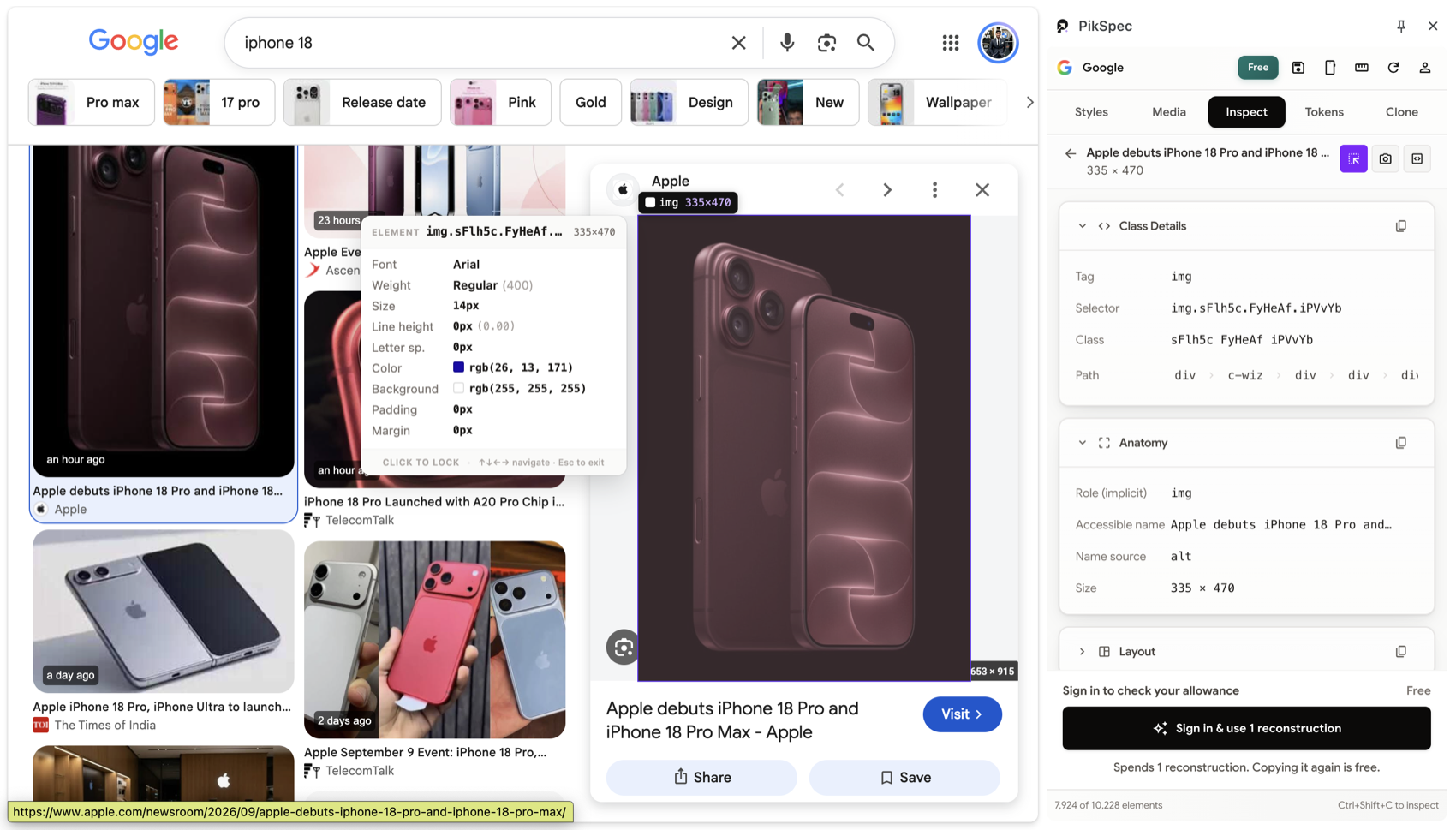
Behind the inspector are three doors into the same capture: read the styles, take the tokens, clone the page. I drew that split on day six and shipped it, because I knew what was behind each door. Then I rewrote the welcome state three separate times trying to make a first-time user know it too.
Three rewrites of the same screen means the decision under it was wrong. Act three opens with the number that proved it.
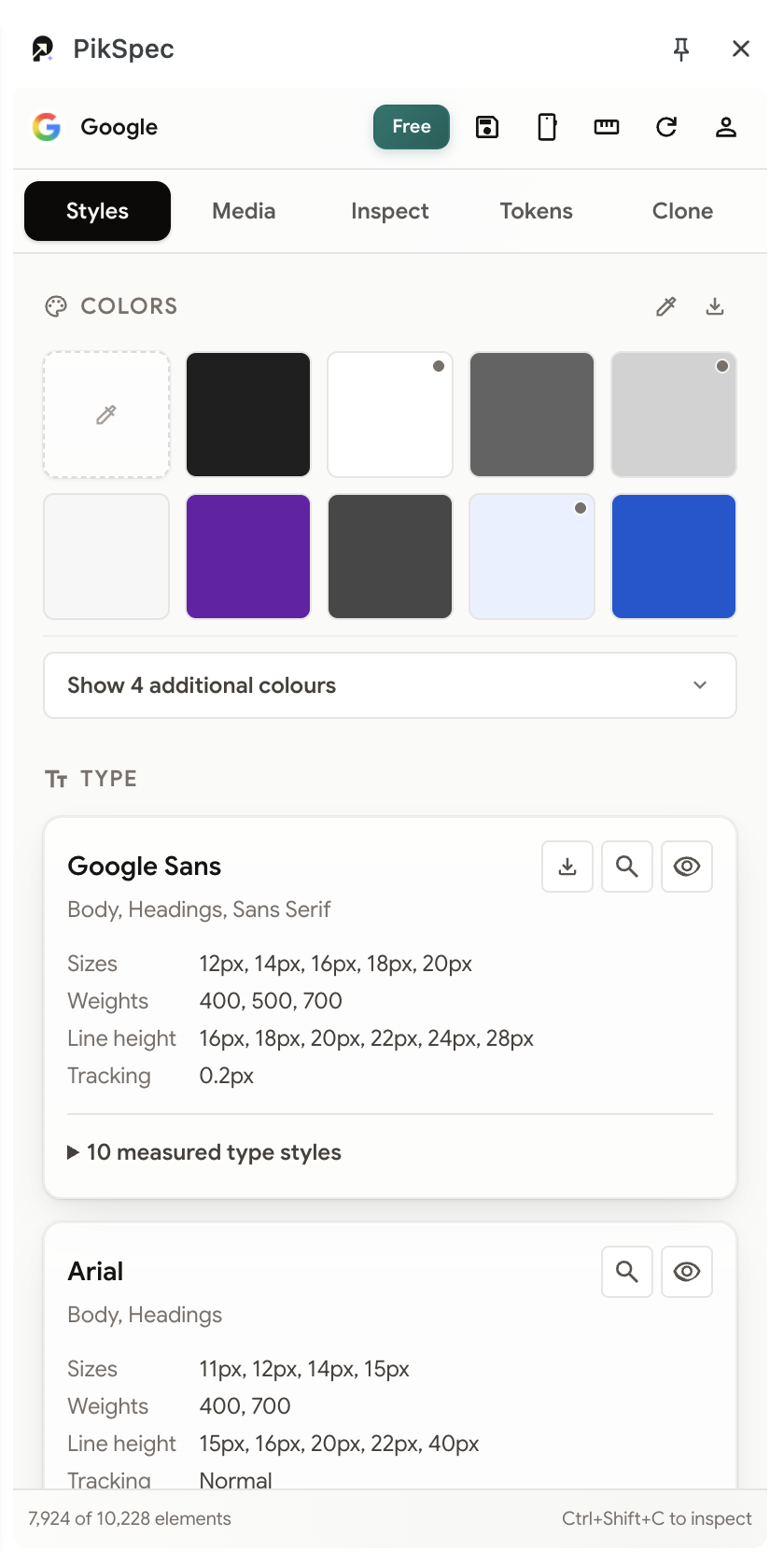
What the page is made of.
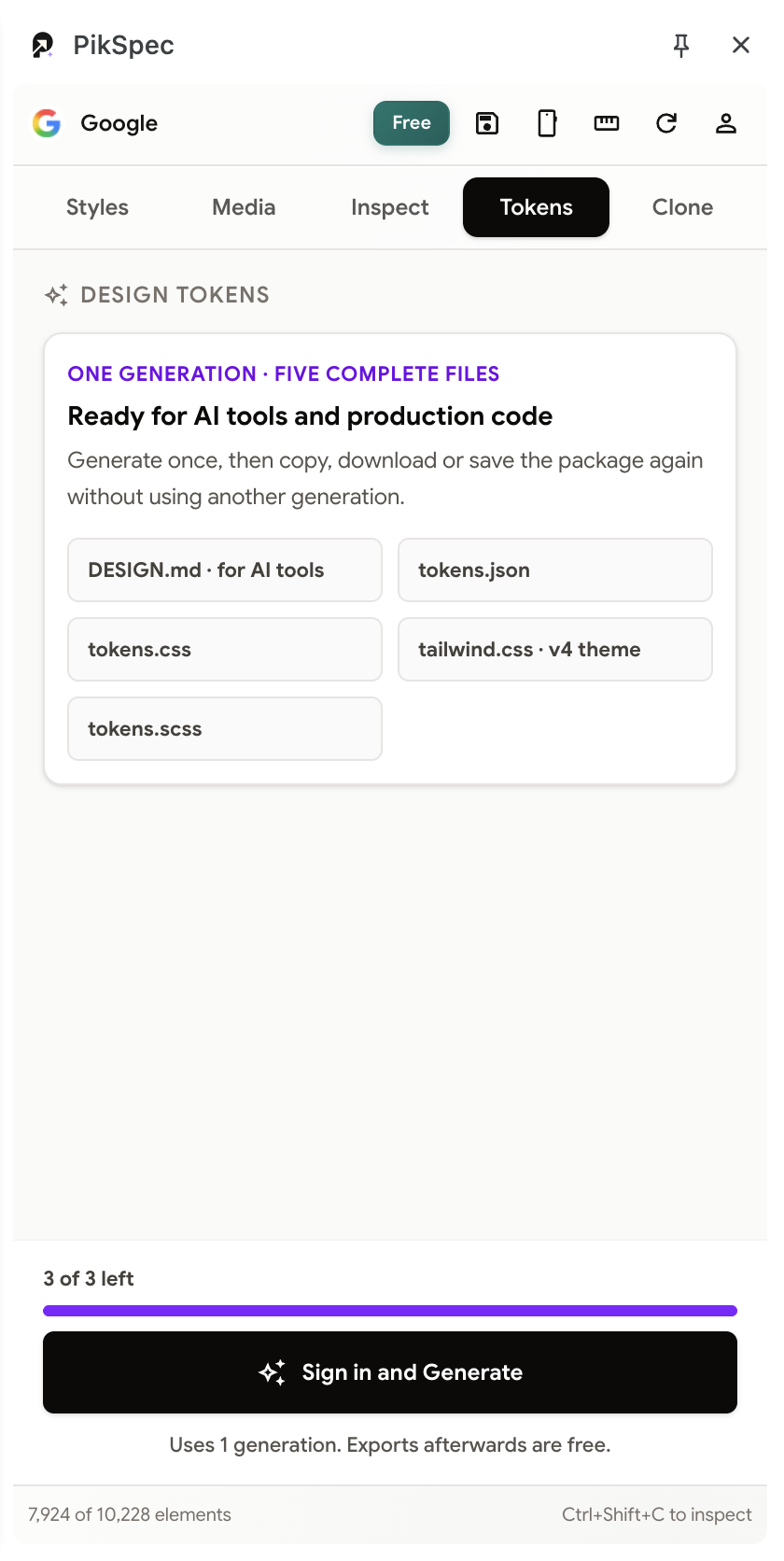
One generation, five files. Copying and re-downloading are free.
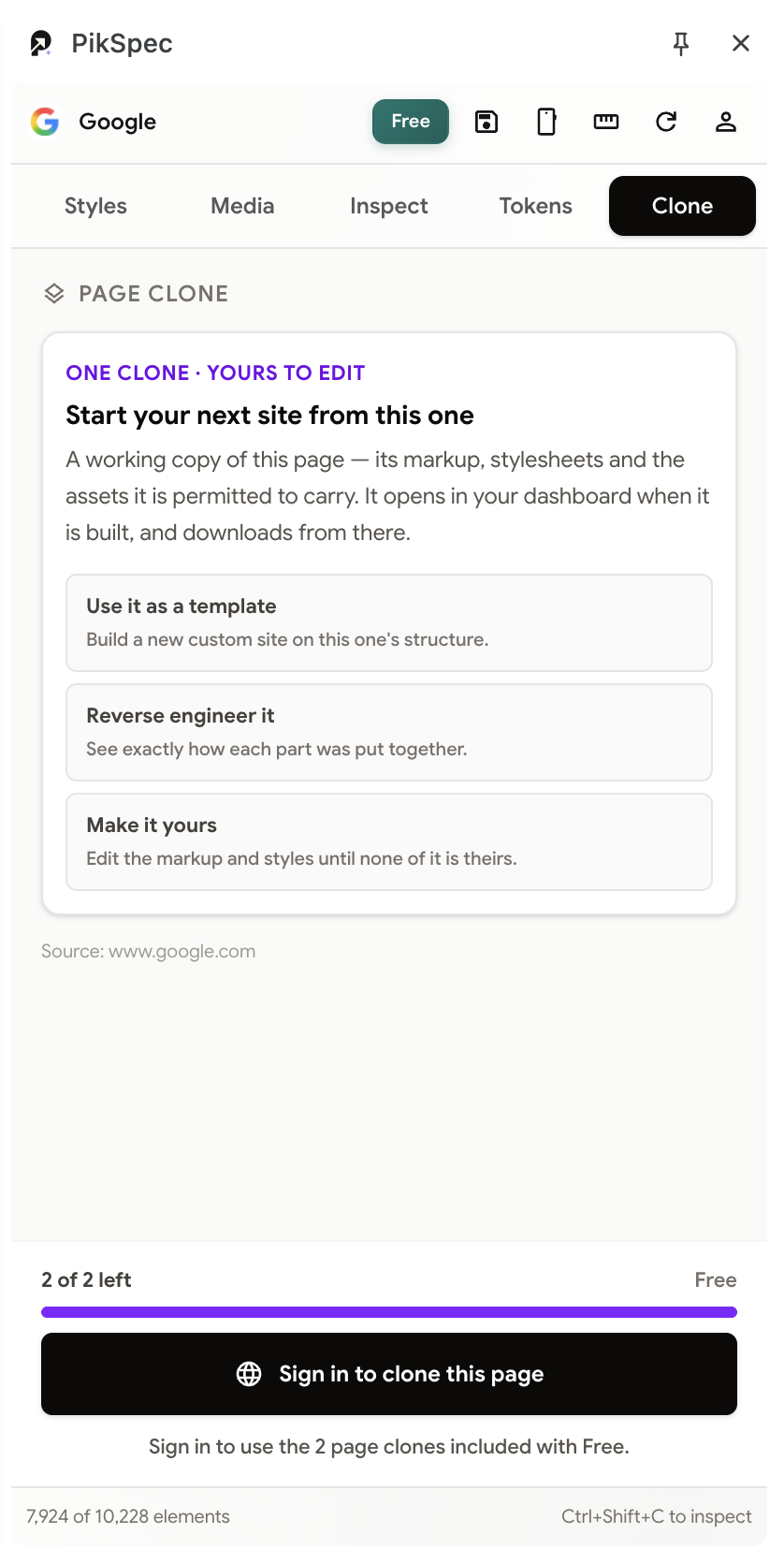
A working copy, carrying only the assets it is permitted to.
The welcome state lands in the same position in all three, so the first action never moves. That part worked; splitting the capture three ways did not.
06 A design system, written from a page
One capture becomes a navigable document: foundations, then components drawn from the page's own values, then guidelines. It ships as a single self-contained HTML file with a sidebar, a light and a dark mode, and no build step, so it opens on any machine with nothing installed and no account.
Three of them, generated by the extension and hosted here exactly as it wrote them. Open them.
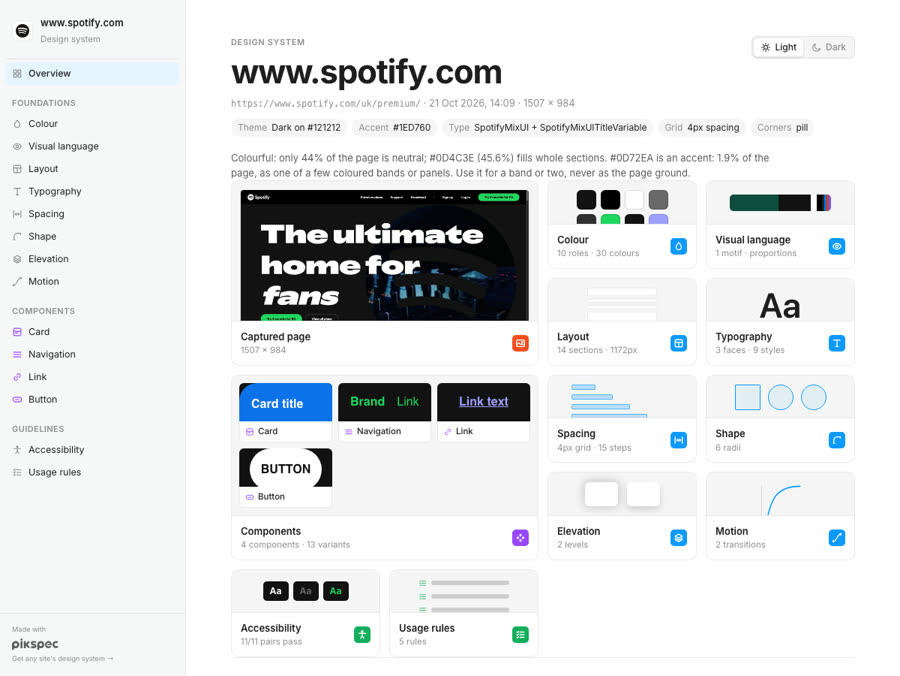 www.spotify.com21 Oct 2026
Ten colour roles out of thirty colours, three faces, fourteen sections, and a 4px grid with fifteen steps. Eleven of eleven contrast pairs pass. The disciplined one.
Open it →
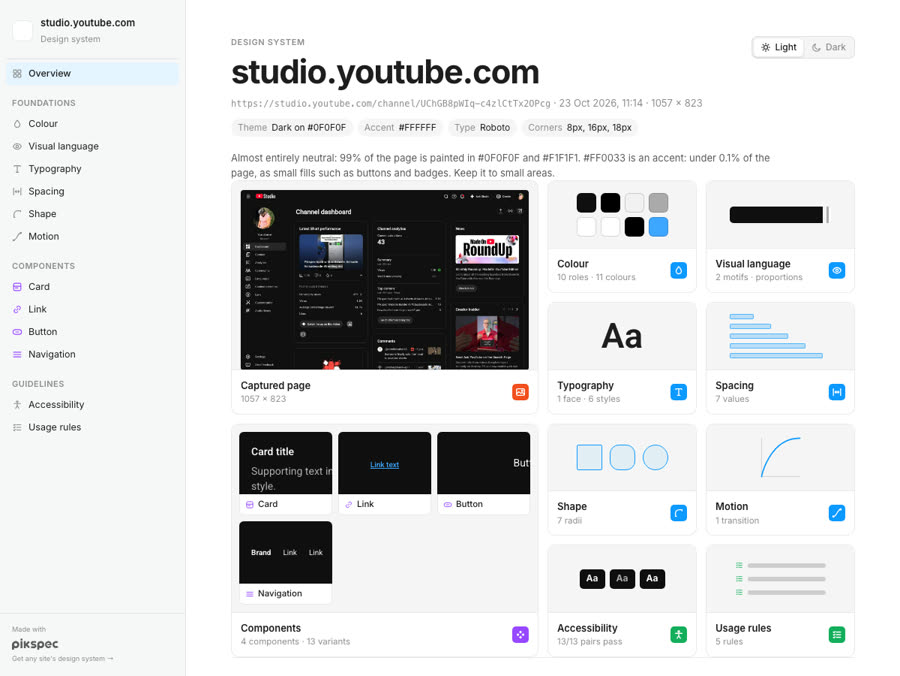 studio.youtube.com23 Oct 2026
One face, six styles, eleven colours, seven radii, a single transition. No consistent spacing grid across its seven values. Restraint everywhere except the ruler.
Open it →
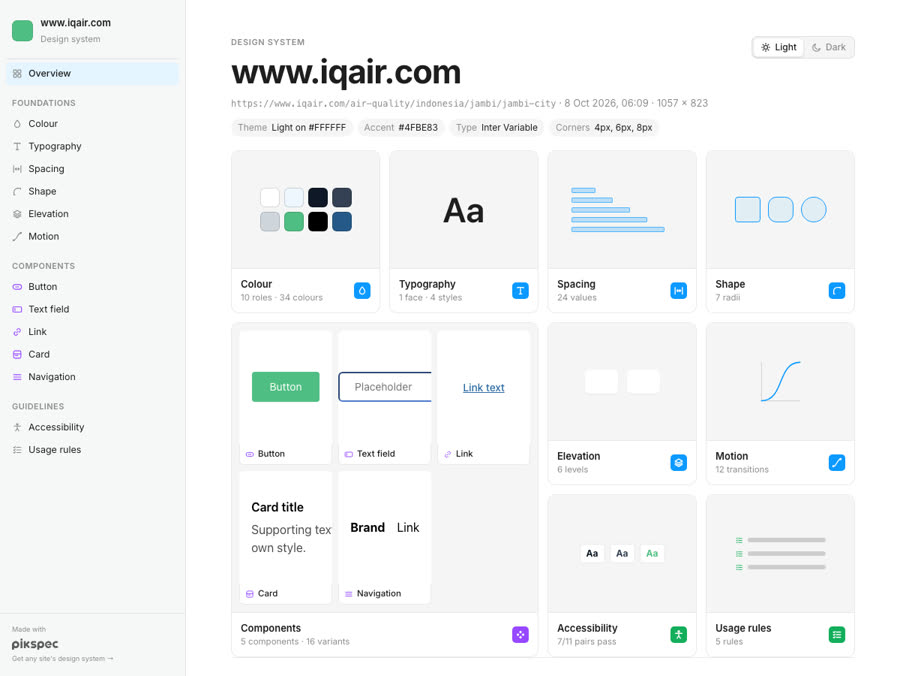 www.iqair.com8 Oct 2026
Thirty-four colours, twenty-four spacing values on no grid at all, six elevation levels and twelve transitions. Seven of eleven contrast pairs pass.
Open it →
Same generator, three very different answers. It reports the page it was given, including the parts a design team would rather not see written down.
IQAir fails four of its eleven contrast pairs and the document says so, in the same type
size as everything that passes. Nothing rounds up. That rule comes from one line in
PikSpec's own DESIGN.md.
Partial, inferred, restricted, stale and failed evidence never masquerades as complete.
DESIGN.md, principle six: uncertainty stays visible
Here is that principle at the token level. Fifty-five colour tokens came out of one real capture. Eleven were measured. The other forty-four are ramp steps the extractor derived at a confidence of 0.72. A product whose whole job is reporting what it found in somebody else's interface cannot let those look the same. Press the second button.
spotify.com/uk/premium, captured 15 September 2026. The pack's own rules say it out loud: do not describe inferred ramps as directly measured values.
07 Production told me I had solved the wrong problem
I had spent two months designing for suspicion. Detect the extension without reading tabs, explain the redaction before it happens, name every refusal in the pack. I was certain the hard part was getting someone to let a stranger's extension read the page they were on.
On 7 October we read the real numbers for the first time.
One week of installs, 7 October 2026
98 of them stop here
The first two lines are the problem I designed for. The last two are the problem I had.
The trust problem I had designed around for two months did not exist. The drop came one step later: half the people who got the thing working looked at a panel with five tabs on it and closed it.
They had a capture and no next move. So I gave them one. Twelve days after that digest, 1.5 shipped as Build with AI: when a scan finishes, the panel's main action sends the whole capture into the tool the person already builds in.
Open any page, press Build with AI, pick your tool. It arrives as a project that opens in the app with the prompt already typed, not a ZIP to wire up. Coding agents only, because a general chatbot cannot open a saved project.
08 What changed after that
If half the people who scan a page then stop, the product has failed to say what to do next. No amount of pricing work fixes that.
Design Packs went free and unlimited on 13 October, and the download stopped asking anyone to sign in. Live Edit shipped on 20 October, so the thing to do after a scan is change the page in front of you and take your version away, instead of cloning a ZIP and hunting for the text in an editor.
Pricing is design too. The ladder runs from 50 cents a clone down to 23, so the biggest pack is the cheapest per unit, and the free tier is not a trial: one clone for the life of the account, three AI kits, and unlimited Design Packs.
The bottom row is the first product, and the most expensive thing I have helped throw away.
09 What I would still redo
I would read the numbers in week one, not in week nine. Two months of design went into a trust problem that 160 of 161 people did not have, and one week of real data would have pointed me at the empty panel instead. I was designing against the objection I would have raised, which is not the same as the one users had.
I would not ship the three doors. They made sense to me because I knew what lived behind each one, and no first-time user does. I would start from a single capture action and let Styles, Tokens and Clone reveal themselves out of what the person actually captured.